English
The ENGLISH CURRICULUM at Cotmanhay Infant and Nursery School
🧍♀️ ENGLISH LEAD = MISS STALLARD
English Overview
At Cotmanhay Infant and Nursery School we develop children’s abilities to listen, speak, read and write for a wide range of purposes. Children learn to use language to communicate ideas, views and feelings. This enables children to express themselves creatively and imaginatively both verbally and through the written word. We aim to share with children the joy of reading and to help them to become life-long enthusiastic readers able to access and enjoy stories, poetry and drama, as well as non-fiction and media texts.
Reading
INTENT:
Our reading curriculum is designed to:
- To deliver the National curriculum for Reading and to ensure that all children are able to access and achieve the end of Key stage outcomes / achieve ELG in reading.
- To foster in our children an enthusiasm for reading, developing resilience and confidence and gain a life-long love of reading
- To achieve this through high quality resources, modelling by well-trained adults and enrichment activities throughout the year including celebrations and visitors to school.
- Enable children to apply their developing reading skills to all other subject areas for research and pleasure.
- Curriculum planning shows clear links between reading and other learning in school through a ‘Creative Curriculum’ approach.
- Phonics is the primary strategy taught to enable the children to acquire the necessary skills to learn to read using blending alongside knowledge of CEWs.
- All staff are well trained and skilled to deliver effective daily phonics lessons.
- Staff are clear about what specific skills and knowledge the children need to know in order to learn to read with confidence.
- Grids have been developed to show skills and knowledge progression in reading from 2 – 7 years.
- Staff identify gaps in learning through regular, systematic assessment.
IMPLEMENTATION
We make this happen by:
- Reading is taught using The Little Wandle Systematic Synthetic Phonics (SSP) scheme.
- All children access a daily phonics lesson.
- Information about what the children are learning in phonics is sent home every week. This includes which Grapheme-Phoneme-Correspondence (GPC) we are learning as well as tricky/ common exception words.
- A link to our Little Wandle SSP “information for parents” section is sent home every week.
- Reading is taught through shared, individual and guided reading every week – in whole class and ability groups with texts closely matched to the reading ability of the children, particularly to their phonic ability. This is taught as set out in our SSP.
- Reading is taught through 1-1 reading sessions with a teacher and trained TA .
- Reading is taught through daily story time in class and assembly giving children access to a wide variety of high-quality books.
- Reading is taught through carefully planned intervention sessions, with particular emphasis given to DP and SEND children.
- Children have daily access to fact books and stories linked to topics.
- Every classroom has an attractive reading zone which all children can access and to the school library with a wide variety of story, poetry, fact books and comics.
- Teachers plan in teams to ensure sharing of good practice and consistency.
- Teaching staff receive regular updates and reminders about good practice and age-related expectations.
- All staff have received training from our SSP.
- ‘Buddy Readers’ gives older, more able readers the opportunity to share their enthusiasm with younger readers.
- The teaching of reading is progressive –teachers are aware of previous learning and potential gaps – in order to plan and implement lessons appropriate to develop the skills needed to be confident, fluent readers with sound comprehension skills. (see Skills and knowledge grids)
- Children are aware of the age-related expectations and reference is made to our ‘targets’ during reading lessons. These are also displayed in class.
- Children are given opportunities to develop, practise and consolidate their developing phonic skills in well planned and differentiated independent phonic tasks (in addition to our daily phonics lesson)
- Assessment of phonics is systematic and takes place every half term in accordance with our SSP. This is consistent across all stages and is used to inform grouping and future planning.
- Children with identified gaps will receive additional support in class and will take part in intervention.
- Readers are closely tracked in EYFS and interventions take place daily in addition to target readers.
- All of our children (from 2-year old Cubs) have the opportunity to take books home to read
- Children have access to collections of age-appropriate books by the same author.
- Strong emphasis is placed on engaging families to encourage reading for pleasure and reading at home.
- Events throughout the year include celebration of World Book Day, Reading challenges during school holidays, participation in the local library reading challenge, Book Swaps, Book Sales and invited visitors including poets and story tellers.
- Every class uses Core books, carefully chosen for each year band.
- Information to support families to read is sent home and can also be found on our website.
- Staff have received ‘Word Aware’ training and a strong emphasis is placed on language comprehension. Displays in class reinforce this.
Reading intervention includes:
- Target readers – reading individually with identified children to support use of phonics / blending
- Working in small groups or individually with well trained TAs on SSP targets to support specific gaps / delays with reading
- Phonic intervention groups in year 1 and 2 prior to the Phonic Screen Check in June.
IMPACT
We measure how well we are doing by:
- Pupil discussion shows evidence of greater resilience and willingness to persevere with reading than in previous years – leading to better outcomes.
- Effective intervention ensures that children achieve good outcomes in reading and phonics.
- Staff report that The Little Wandle SSP has had a positive impact on the way we teach phonics / reading at our school and shows in better outcomes for all groups of children for GPC and blending / segmenting.
For more information please visit our reading focus page
Writing
INTENT:
Our writing curriculum is designed to:
- To deliver the National curriculum for Writing and to ensure that all children are able to access and achieve the end of Key stage outcomes / achieve ELG in writing
- Provide meaningful and well planned writing opportunities through other subject areas including history, geography and science.
- Close links between the teaching of writing and phonics so the children are able to acquire the necessary phonics skills to learn to spell by segmenting using GPCs (as set out in our Little Wandle SSP)
- To enable all of our children to spell common exception words to allow writing fluency.
- To enable all of our children to write with fluency, confidence and purpose.
- To develop in our children a broad vocabulary and a good understanding of how to use language in their writing.
- To ensure teachers are familiar with the expectations of the curriculum and the age-related outcomes.
- To provide rich and varied opportunities to write for a broad range of purposes at a level which is appropriate for all groups of children.
- To develop in all of our children the knowledge and skills to enable them to communicate their ideas in writing so that they may fully participate and contribute to society.
Implementation
We make this happen by:
- Staff follow the long term English overview plans which have been developed in teams and are updated regularly.
- Every class (including our 2 year Cubs) have well-resourced and attractive independent writing zones where children’s writing is celebrated and displayed. Opportunities to write are also provided in role play areas across school.
- The learning environment provides access to key vocabulary and useful displays in class as well as phoneme and word mats to aid independence in writing.
- Spelling words are sent home weekly with a link to the Little Wandle parents information section of the website. This includes words with the graphemes of the week and common exception words.
- Handwriting takes place following the Little Wandle SSP and in handwriting groups following the Penpals scheme. Children learn and practise all joins as they become ready.
- Children are encouraged to read their writing back to check and edit if necessary.
- In Key Stage 1 Spelling, punctuation and grammar lessons ensure that children are acquiring the appropriate skills which they can apply to their independent writing.
- Regular “quick write” dictation sessions occur throughout school to build writing fluency.
- At Key Stage 1 the spelling of common exception words is taught in accordance with our SSP and assessed regularly.
- Teachers plan in teams to ensure sharing of good practice and consistency in the teaching of writing across school.
- Work samples are moderated by SLT, within year bands and at staff meetings involving all staff and with local schools to ensure accurate and consistent judgements.
- The English Leader monitors the teaching of writing closely with a combination of planning scrutiny, pupil discussion, work scrutiny and lesson visits.
- CPD continues throughout the year following English Leadership Briefings
- Enrichment activities such as visiting story tellers and poets inspire children to write for pleasure.
- Our younger children (and older SEND children) engage in early writing development activities such as “Squiggle while you Wiggle” and “Dough Disco” to develop writing muscles, handwriting patterns and good writing habits from the age of 2.
- Children in reception follow the Drawing Club scheme in addition to other writing opportunities in class.
- Children with SEND receive extra support and work on SSP targets with a trained TA for specific skills development, identified by continuous assessment.
Impact
Recent pupil discussion, writing scrutiny and lesson visits show evidence of:
- Improved resilience and confidence to write.
- Greater output of writing at one time than previously.
- The children’s ability to apply their phonics knowledge in their spelling choices.
- Children feeling confident to check their own writing and make changes where necessary without it interrupting the fluency of the writing itself. These were observed throughout school from Bears – year 2.
Handwriting
In the Foundation Stage children develop many pre-writing skills. Correct letter formation is taught in a variety of enjoyable ways. As they become able, children begin to write letters using a variety of materials. Children are taught how to hold their pencil correctly. Children learn to regulate the size of letters, which leads to neatly presented work. Letter formation is taught alongside learning the letter sounds in the order set out in Little Wandle. When children are ready, they are taught to join letters following the Penpals scheme.
Spoken language
At Cotmanhay Infant and Nursery School we recognise that good spoken language skills are crucial and every opportunity is taken to develop good speech and language skills throughout school to enable our children to be confident, creative and successful communicators.
Throughout the year we run many interventions to support children who need extra help to develop good spoken language skills including ECAT and Speech Link.
Experienced, trained TAs deliver specific and individualised programs of support (set by the Speech and Language Therapist) for children who experience Speech and Language difficulties.
Teachers have received Word Aware training to better enable staff to develop children’s vocabulary and expressive language. We place a strong emphasis on broadening the children’s vocabulary and all year bands have a bank of key words to hear, understand and use which link to termly topics. These words are displayed in class and sent home with the termly information letter about what we will be learning.
Developing Oracy skills at Cotmanhay Infant and Nursery School
We recognise that developing good speaking and listening skills is crucial in enabling the children to access all areas of the curriculum.
We recognise that oracy is as important as reading and writing and forms an integral part of learning in all subject areas.
We recognise that without good oracy skills our children will not be equipped to participate fully in society.
We aim to develop good oracy skills throughout school from Cubs and Bears nursery, though the EYFS and key stage 1.
We deliver the statutory requirements set out in the EYFS guidance and the national curriculum for Key Stage 1. (see our skills and knowledge grid for Spoken Language and our Oracy progression documents)
We provide the following opportunities for the children to develop the best oracy skills possible:
- Setting out expectations for Active Listening with visual prompts in all areas of school.
- Ensuring all staff are aware of good practice and expectations through regular reminders/CPD and Word Aware training.
- Key vocabulary for all subjects used consistently throughout school.
- Vocabulary development following the Word Aware principles and having words of the day / week / word jars in classrooms.
- Regular opportunities for talking partners across different subject areas.
- Encouragement to compose and orally rehearse prior to writing.
- Daily story time used for oracy development. Responding to stories / poems and sharing ideas and opinions.
- Show and tell opportunities – short presentations and asking / answering questions.
- Oral story telling opportunities which may be linked to topics.
- Role-play areas in every classroom with the opportunities to use imaginative language through play.
- Key vocabulary on display and changed termly – shared with parents.
- Strong emphasis on the importance of “maths talk” during all maths learning including during daily maths fluency sessions.
- Use of sentence stems to scaffold reasoning and explanation.
PLEASE SEE THE ORACY PROGRESSION OVERVIEWS AT THE BOTTOM OF THIS PAGE
Phonics
We have a whole page dedicated to the teaching and learning of phonics in our school. Please click on the link below to access our phonics page.
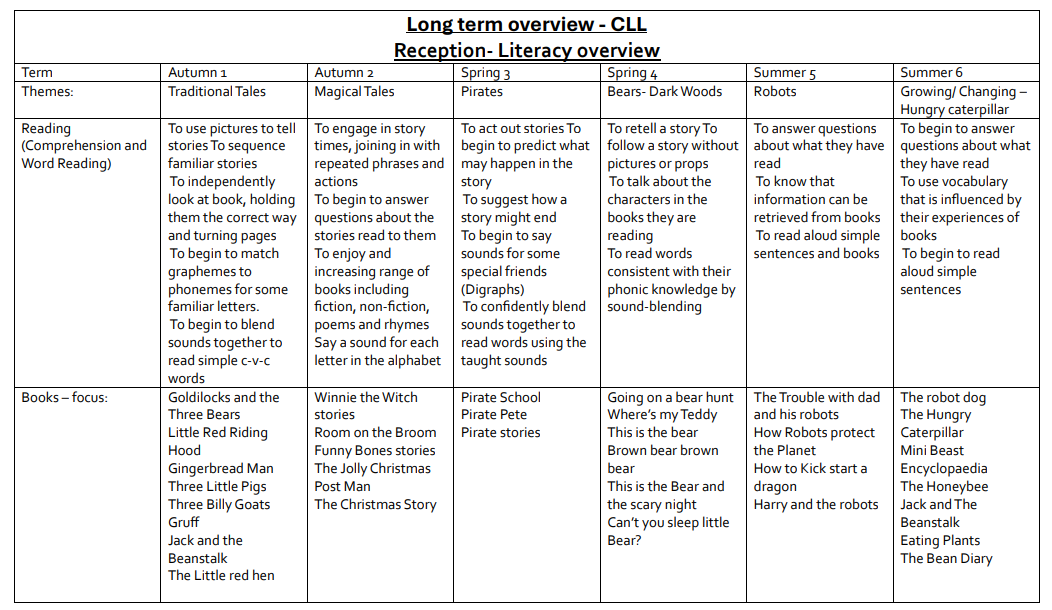
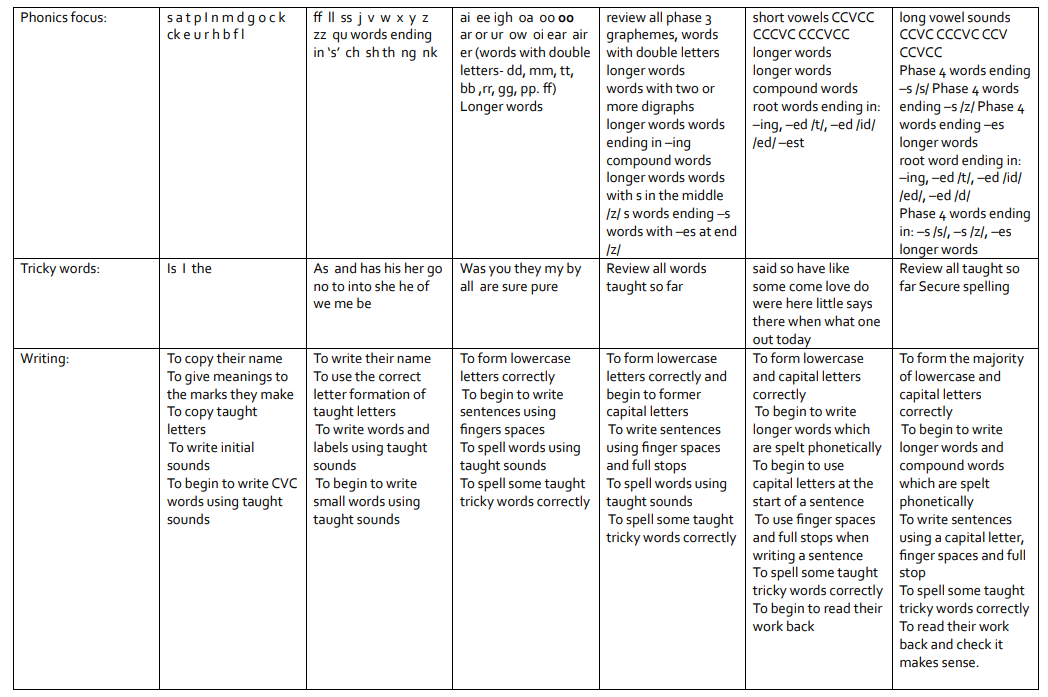
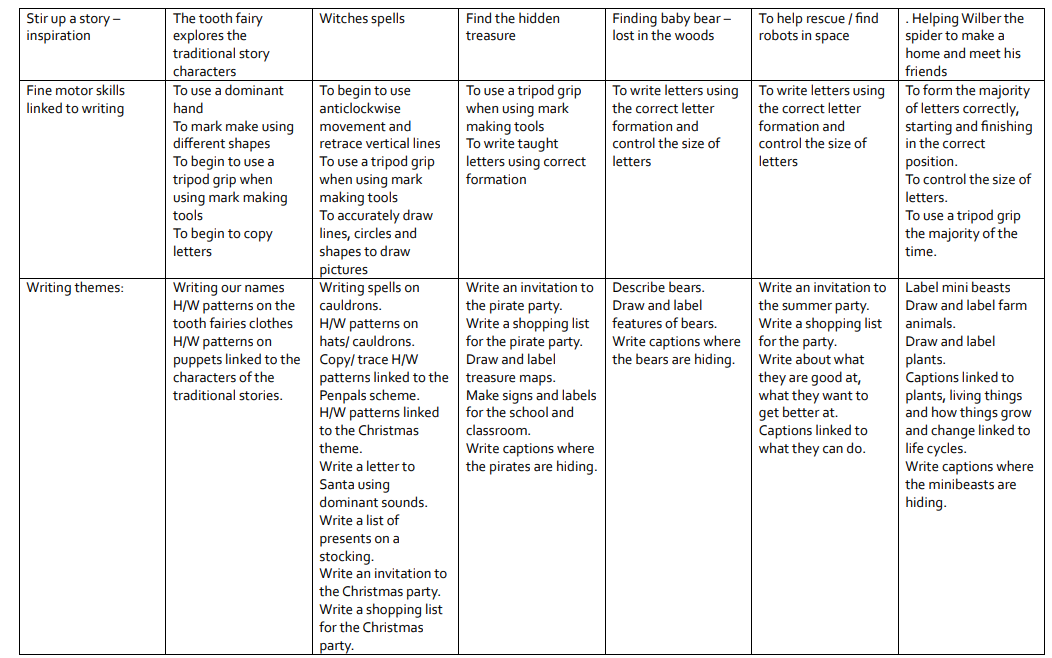
RECEPTION ENGLISH LONG TERM OVERVIEW
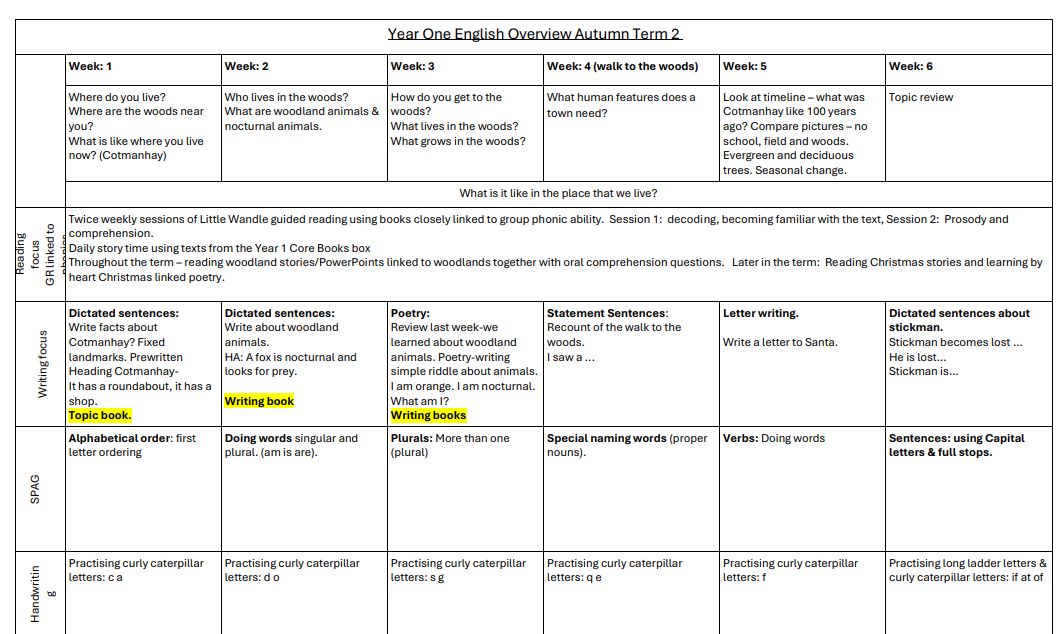
YEAR ONE SAMPLE ENGLISH OVERVIEW
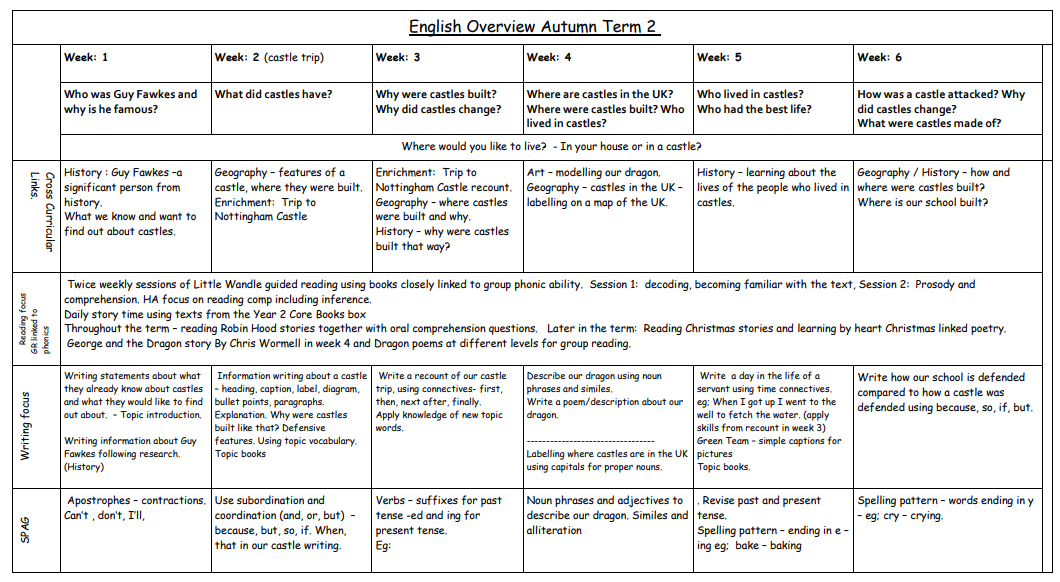
YEAR 2 SAMPLE ENGLISH OVERVIEW